A home robot earns its place by doing one repeat task without constant help. That may mean cleaning a floor, carrying items, watching a room, or helping someone follow a daily routine.
The useful question for a household is not whether a robot looks advanced. It is whether the machine saves work, fits the home, and keeps working after the first week.
- Best fit: repeat tasks with clear rules
- Main limit: homes change from one room and day to the next
- Buyer check: price, charging, noise, upkeep, and privacy
Where home robots help first
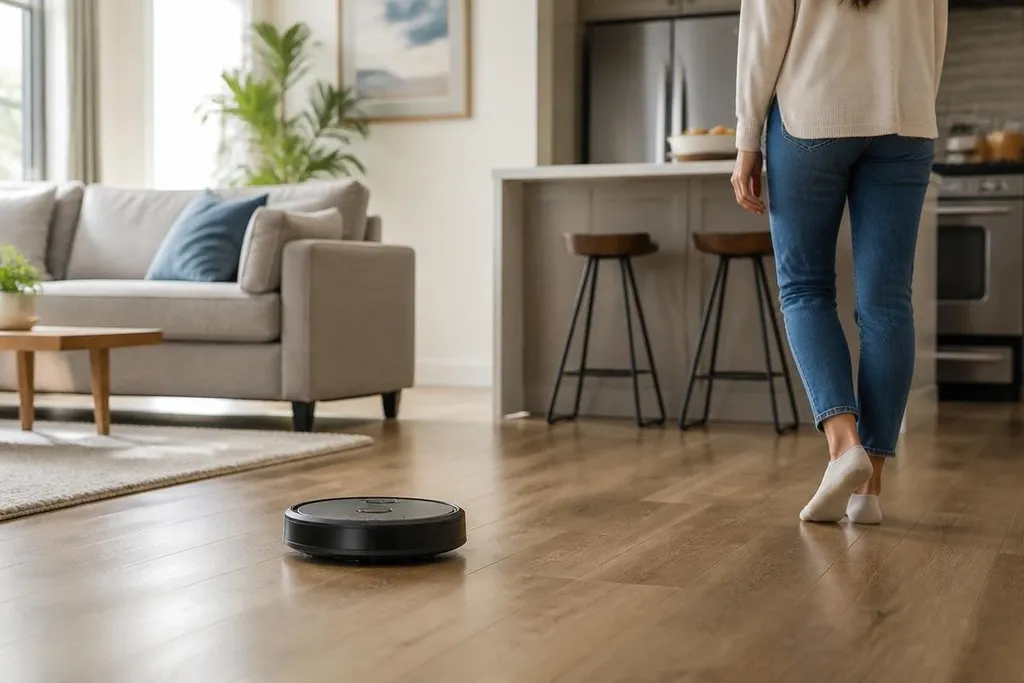
Cleaning remains the clearest use because floors and lawns offer fixed spaces. A robot vacuum can follow a planned route, return to its dock, and run while people are away.
A lawn mower can repeat a mapped path when its boundary system keeps it inside the work area. That pattern matters because the task happens often, and repeated runs remove a small job from the household schedule.
The benefit depends on how much setup the robot needs before each run. Care and monitoring bring a different use, since a robot with a camera can check a room, send an alert, or let a person see what is happening from another location.
Blocked doors expose a home robot’s first limit: it needs a clear path, a charged battery, and a working network. Reports from Robot24 can connect those daily problems with tests of autonomous systems and household safety before the next section looks at why homes are harder than demos.
The house is harder than the demo
A home contains steps, loose cables, pets, narrow gaps, glass doors, low furniture, and objects that move. A robot may work well on a clear floor and struggle when a chair, toy, or bag changes the route.
This problem comes from perception and control. Sensors collect information about nearby objects, while software decides where the robot should move. The robot must then act on that decision without hitting people, damaging property, or becoming stuck.
Small changes can matter. A dark rug may look different from a light floor to a camera. A charging dock may work in one room but become hard to reach after furniture moves. These details shape daily use more than a long feature list.
What changes for people at home
The main change is the shift from doing a task to managing a system. You may need to clear the floor, empty a dust bin, clean sensors, update software, or move the dock before the robot can work well.
That trade is useful when the machine handles a repeat job with little attention. It is weaker when each run needs several corrections. A robot that needs help every few minutes has moved the work rather than removed it.
Privacy also becomes part of the household decision. Cameras, microphones, maps, and cloud services can collect information about rooms and routines. A buyer needs clear answers about where data is stored, how long it stays there, and whether the robot can work without an internet connection.
The limits buyers should check
Prices and features vary by product, so compare the exact model rather than the product category. Ask the seller for the battery runtime, charging time, noise level, repair terms, replacement part costs, and software support period.
The claims that matter most are easy to test on paper. Look for the floor types the robot supports, the objects it can detect, the areas it can enter, and the tasks it cannot perform without remote control.
I’d wait on any home robot whose maker has not explained data storage, repair support, and failure recovery.
A practical buying check
Use this list before you pay:
- Name the task: write down the exact job you want removed.
- Measure the space: note steps, narrow doors, rugs, cables, and floor changes.
- Check the routine: find out what you must empty, clean, refill, or move.
- Read the data terms: check camera, microphone, map, cloud, and account needs.
- Price the upkeep: include filters, brushes, batteries, bags, repairs, and service.
- Plan for failure: decide what happens when the robot gets stuck or loses power.
Home robots will change daily life in small, repeated ways before they handle open-ended household work. The useful test is simple: after 30 days, does the robot complete its task with less attention than the task used to require?